

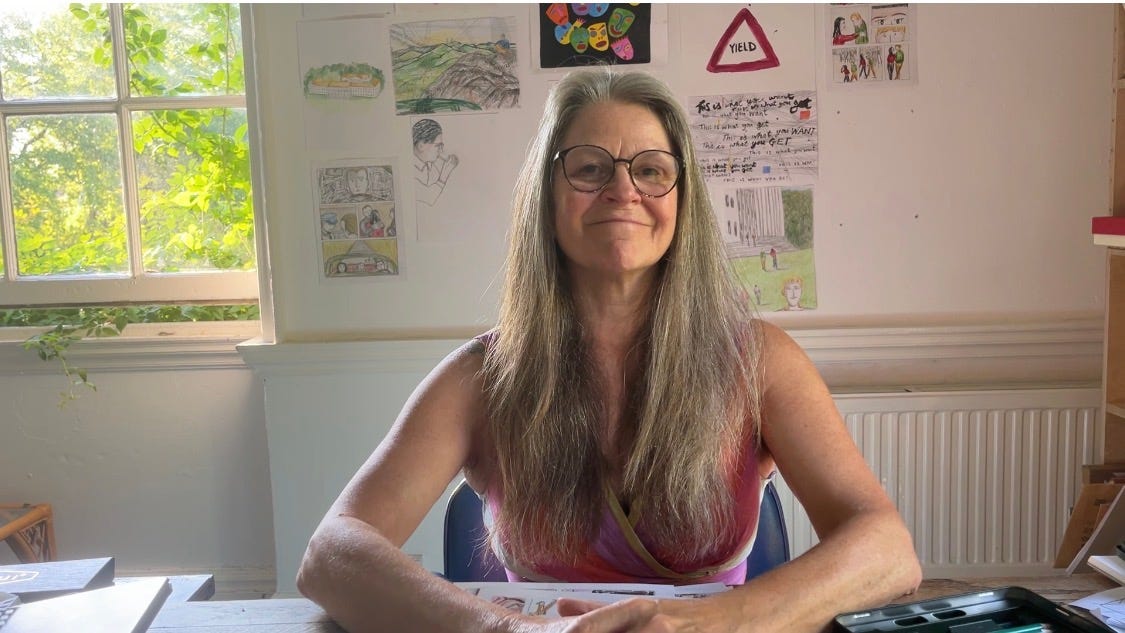
Finally, in 2022, the shape of my idea began to form.
I started reading about Black Mountain College, where my great uncle had been a founding member. It was at this point that I began to understand the importance of the farm at the college. I was thinking that the structure of my narrative could be shaped by the principles of Permaculture, so this felt like an obvious connection. I could tell the origin story of Black Mountain College, and its farm, through the lens of my uncle, with a narrative arc informed by Permaculture principles.
The familial connection to Black Mountain College was an important catalyst, but there were other connections too.
Since 2022, my husband John, and I have lived as custodians of The Grange in Norfolk, which was redesigned in 2012 as a Permaculture site. In our first year here, we began hosting artist residencies. We wanted to pass on the generosity of the owners of The Grange, so our intention was to cover the costs of running the place rather than create a profit-motivated business.
Like Black Mountain College, we asked for payment to come to The Grange. We have had decades of experience writing bids for public funding, and it is good work, but it always demands that what you are doing is working towards something bigger. At this stage of our lives and careers, we are more interested in championing the shrinking and the importance of the process, rather than the outcome.
We run our ten-day residencies on a pay-what-you-can basis and don’t take salaries. This allows those who can pay more to support those who cannot pay our guideline amount. Our motivation has become more and more about establishing a place for critical discussion, in an environment that offers time, space and conviviality.
I began to increasingly sense the DNA of Black Mountain College, and of my great uncle John Evarts in our daily life.
Then, through my online research, I came across a wonderful archive of Black Mountain College photographs, put together by the American academic David Silver. I reached out, introduced myself and outlined my idea, and we had some email exchanges.
I was new to the world of Black Mountain College research indeed, to its history. We had a copy of Black Mountain: An Exploration in Community by Martin Duberman, the book my uncle gave my family when it came out in 1972. The starting point for my research in 2022 was a close reading of this book. Luckily, I was approaching it armed with a PhD, because it is a formidable and brilliant piece of research, and very dense reading.
Then two things happened.
First: David Silver pointed out that his twelve-year research into the farm at Black Mountain College was about to be published. He asked what my book would contribute that his research had not covered.
Second: the Duberman book outlines the homosexual strand of Black Mountain College. There is a specific reference to a “John Doe” who asks for the tape recorder to be switched off during an interview and then talks about the conflict of being a homosexual at Black Mountain College.
Two things were confirmed for me.
First: I had, and have, no interest in farming, the make-up of soil, plant types or different land management methods. My interest in Permaculture from the start had been an interpretation of its principles through a social lens. The farm, and perhaps the Permaculture framework itself, had been a red herring.
Second: I reckoned “John Doe” was my great uncle, and that the book should be about that.
With a PhD in Gender Studies, this seemed like a no-brainer. It was much more within my interest and comfort zone.
By this point, I had successfully applied for a Develop Your Creative Practice Arts Council England award to visit the Black Mountain College archives in North Carolina, as well as to take part in the GroundWork Gallery (Kings Lynn, Norfolk, UK) residency.
YIELD was beginning to take shape.
But there have been a couple more years of process to document before I can tell you about what pencils I use.
Back to the present
My Kickstarter campaign launches in ONE WEEK — 18 August to support the printing of YIELD, the finished graphic novel.
Here’s the link to subscribe to get a reminder
So let me practise telling you what it is about:
YIELD tells the story of a man’s conflict between the personal and the political, as he lives with personal oppression within a progressive environment that advocates freedom.
Then…
Set in 1937 at Black Mountain College, the story is based on my great uncle as one of the twelve founding members.
Thank you for following me here and welcome to new subscribers,
with warm wishes
Nicola