
What's the Point?
Part 1: Community

Every New Year, I ask myself.
WHAT’S THE POINT? of anything.
At the end of 2025 I stepped down from the board of LDComics CIC after 16 years of steering since co-founding in 2009 as Laydeez do Comics. LDC has been a major part of my life, thinking, academic research, and my joy. My friends ask why I left but I ask why I arrived.
WHAT WAS THE POINT?
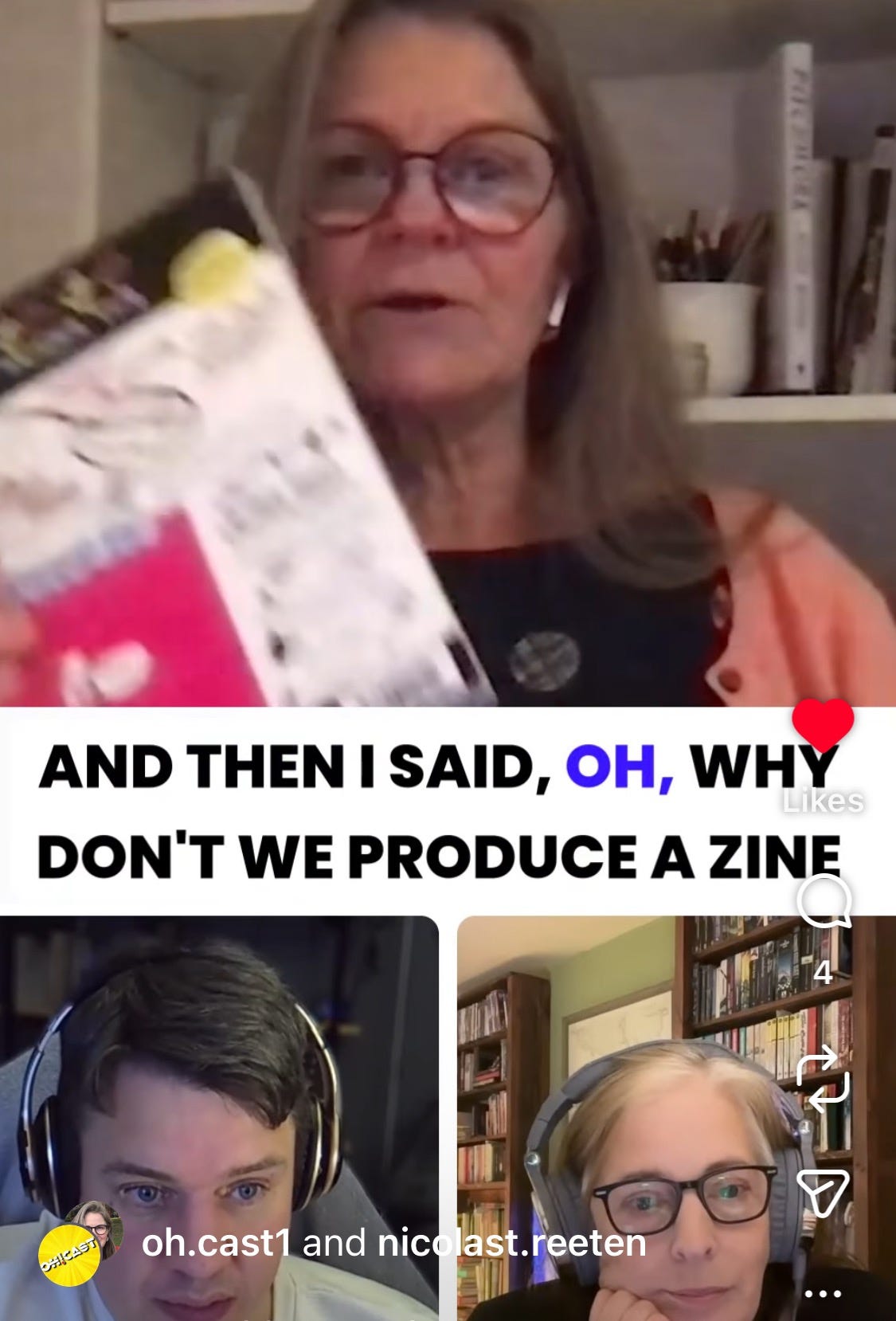
In an interview with OH!CAST A Scottish podcast in the Outer Hebrides I enjoyed an opportunity to talk about my introduction into the world of comics and graphic novels and the origin of LDComics during a conversation with Cal McDonald and Kathleen Milne. I will summarise some of this below but recommend a listen. And they do all sorts of other episodes around popular culture, take a listen, you will not be disappointed.
WHY DID I ARRIVE?
In summer 2009, at a London event called The Graphic Novel, I made a new friend in artist Sarah Lightman. We shared enthusiasms, interests, and knowledge. Our curiosity about comics and graphic novels sprang from a fine art context rather than mainstream comics fandom and our particular interest was autobiographical graphic novels, especially by women. We were both feminists entering post graduate studies and both practitioners working on our graphic memoir projects.
We arranged a meet up at the Wellcome Collection in London to see Bobby Baker’s Diary Drawings, an exhibition of line and watercolour drawings with text, based on her experience of depression. This, we realised, was what ‘comics’ could be. Over coffee, sparks of synergy brewed an idea mid laughter and gossip of forming a sort of regular book group type salon or club where everyone would be welcome to come along – for free - to discuss comics (loosely defined) that focused on life narrative, the domestic and the everyday. What we really wished for was to provide a platform for ourselves and others to share work in progress, test new ideas, and receive feedback, with invited artists who were starting out presenting their work alongside more established practitioners. We felt such a group didn’t exist in the UK so we could start one ourselves.
We started our club and then it turned into a thing.
Taken seriously, striking a chord beyond ourselves. And LDComics continues, with an established legacy. I propose it has significantly influenced comics and graphic novel activity, industry and community in the UK this century. In effect Sarah and I formed our manifesto right there, back of an envelope style - the very best way to generate a constitution. We agreed importance of place. Sarah found little attraction in a pub as our venue because she didn’t drink alcohol, plus the historical traces of masculine space didn’t seem the right fit for us. Our priority was to make our events welcome for everyone, and to be women led. I favoured a non-institutional space because we weren’t an institution.
A few weeks later we held our first Laydeez do Comics monthly meeting at The Rag Factory in Heneage Street, off Brick Lane, a building being renovated to offer rehearsal space to actors, with an appropriate provenance as Tracey Emin’s former studio. We brought projector, extension leads, kettle, Sarah’s home baked cakes and paper cups and launched. We invited guests we found interesting. My first choice was Simone Lia, whose work I was (still am) a fan of. She said she’d prefer not to and suggested Sarah Macintyre, who was a wonderful choice. Sarah Macintyre arrived with her friends, and we arrived with ours. There were perhaps 15 or so people, and the evening was delightful, inspirational, and fun. At the end of 2009, we hosted Posy Simmonds attracting an audience of around 75 people, establishing Laydeez do comics as a hub of the small British comics community.
To sum up, Sarah and I were basically hosting a monthly party. We were funding rental of the space ourselves and spending time to administer - listing the event, inviting guests, baking, hosting, traveling into London. Why on earth would anyone do that?
To return to my opening question, and title
WHAT WAS THE POINT?
The POINT was reward from the stimulation and enjoyment of the events themselves, and meeting people with shared interests. But equally the reward was from the process. The gossipy chats with Sarah along the way, refining our thoughts, reaching out to invite artists we admired to be guests and to friends, family, and the public to come and be audience. We found pleasure in offering welcome, and hospitality. We found satisfaction from hearing how other people enjoyed the events as much as we did. We gave, and we received, and this sense of reciprocity is at the heart of what I began to understand as ‘community’. I also recognised that this community element has been the most important aspect of LDC.
The establishing of community per se was never the point, it was about hosting of a platform. But community happened along the way and then became the point. A friendly and supportive group of creative people with a mixture of backgrounds and practices emerged from those early meetings.
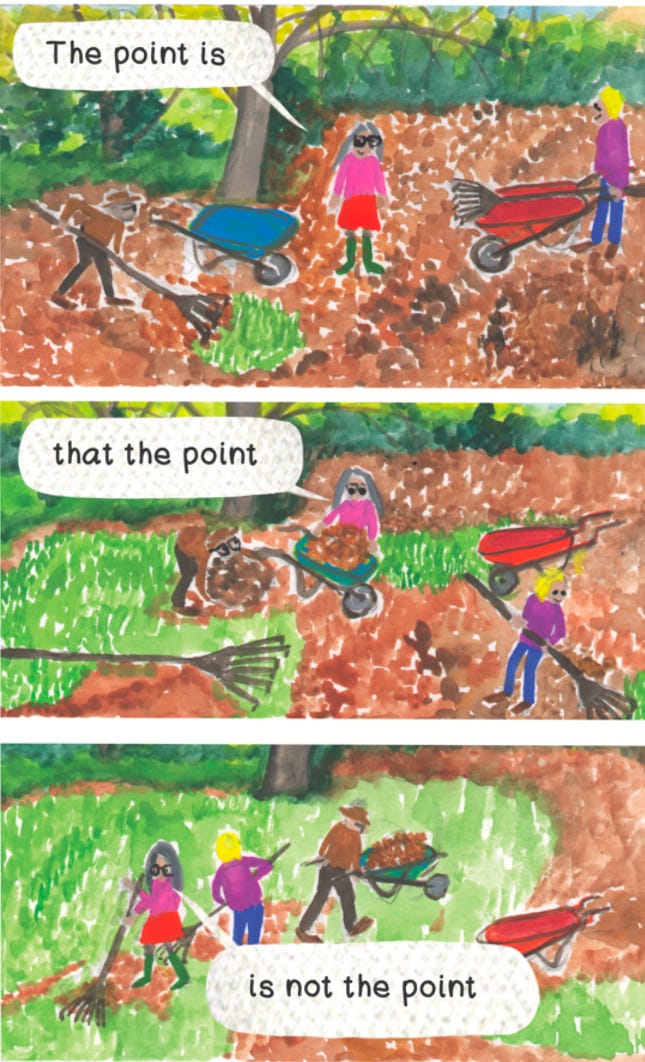
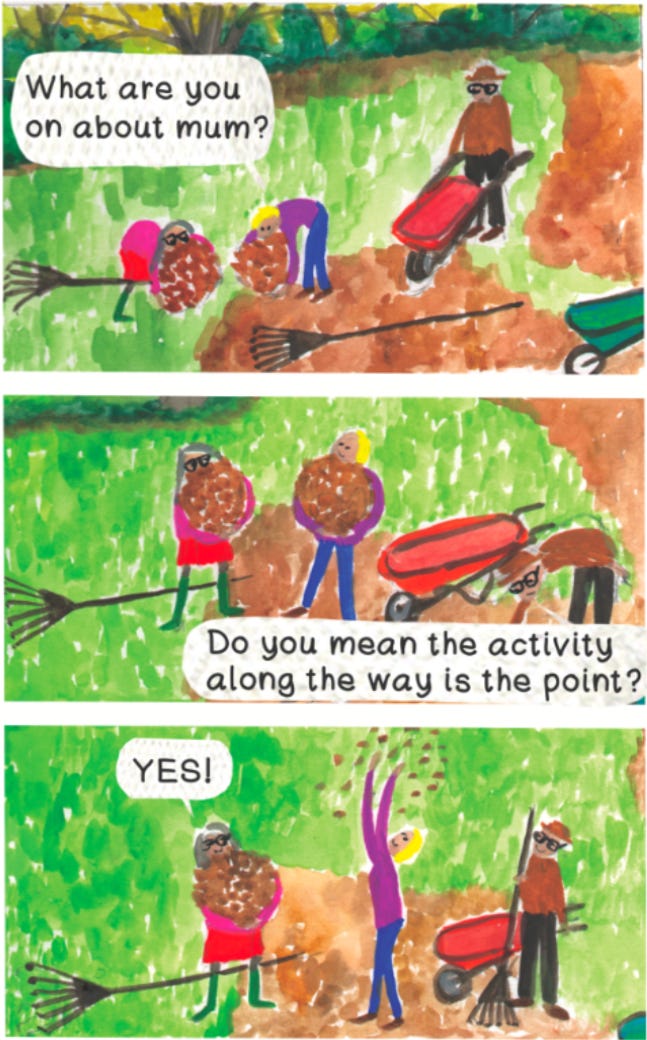
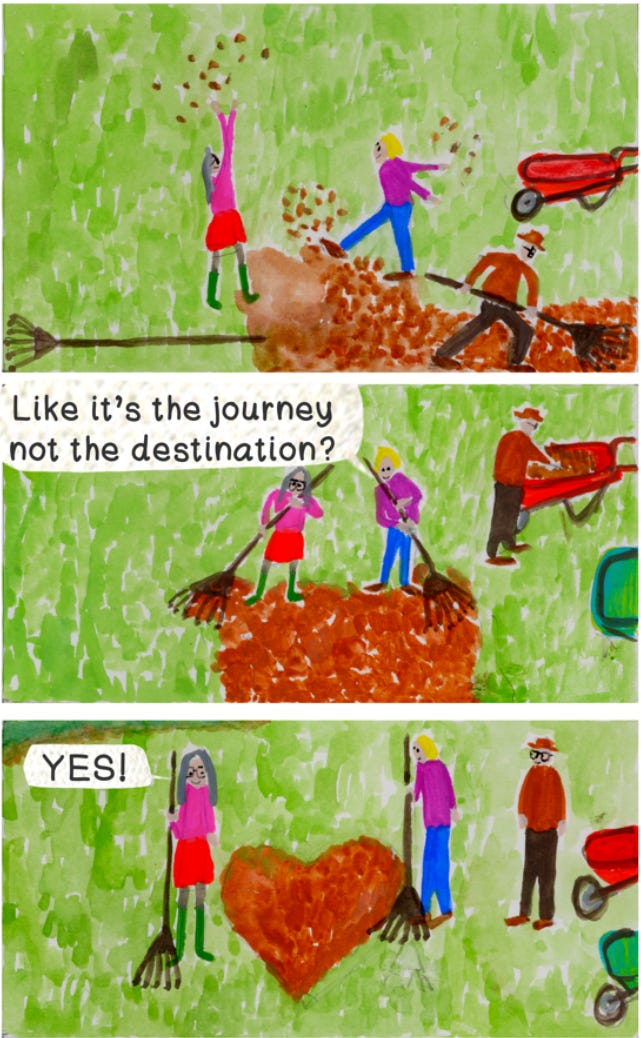
The point is that the point is not the point.

The point is the activity on the way to the point.
WHY HAVE I LEFT LDCOMICS?
I’ve had enough. It’s time to let go and allow new breath to invigorate the activity.
Once I’d made the decision, I reflected that whilst LDC has been fantastically brilliant in hosting online monthly events, for me there is no substitute for in person meetings. Since moving to Norfolk in 2021 and starting to host artists residencies there with my artist spouse John Plowman at The Grange where we live, this has reinforced my belief.
In 2023 I began researching the radical Black Mountain College (1933-1957) whose history has informed YIELD, my graphic novel in progress, I started thinking more about ‘community’. I see LDC, The Grange Projects and Black Mountain College as sharing characteristics, which we may say are on a spectrum of ‘community’.
YIELD is set in 1940 at North Carolina’s Black Mountain College the alternative community with art at the centre of its teaching philosophy. YIELD is a fictionalised history of forbidden queer love with a personal resonance. My uncle, John Evarts was one of the twelve founding members of Black Mountain College. It is this familial connection that initiated my interest. It is my conversations as a teenager with my uncle that were formative in my deeply held conviction in the power of community and creativity.
John Rice, the visionary founder of Black Mountain College argued that community couldn’t work by simply aiming for happiness and contentment, it needed to have a ‘job’ as a focus. In the case of Black Mountain College this was creative and intellectual pursuit as a way to learn. In this way, Rice implied, happiness and contentment could emerge as a by product. In other words, happiness cannot be the POINT but can pop up from the process of activity towards achieving the point.
WHAT’S THE PONT OF COMMUNITY?
and what even do I mean by ‘community’?
In his book Community, sociologist Gerard Delanty defines community as relationships between people and social networks that give us the experience of belonging or not belonging. This is no longer reliant on place, hence the online experience can suffice to make us feel we belong. He also writes about how we can belong to more than one community, for example based on our religion, gender, ethnicity. What he observes is the risk of nostalgia and romanticism in our thinking about community, with the potential for this to be exploited politically. I am perhaps guilty of this romanticism, assuming community to always be a lovely sweet bed of roses. Researching the history of Black Mountain College, along with my previous research into the history of feminism in the UK, the cracks, contradictions and less comfortable elements of community became evident. And it is this aspect that interests me. I wonder if perhaps the frictions, divisions, conflicts and contradictions are essential ingredients in communities that make change.
YIELD is my graphic novel in progress and my substack posts here will be reflections on the philosophical ideas and histories that emerge as part of and alongside my working material process. There have been too many ideas to shoehorn into my graphic novel, and this gives me space …
What are your thoughts and/or experiences of ‘community’? Good, bad, ugly? Leave a comment, let me know.