

SILENCE
The bifurcation of self
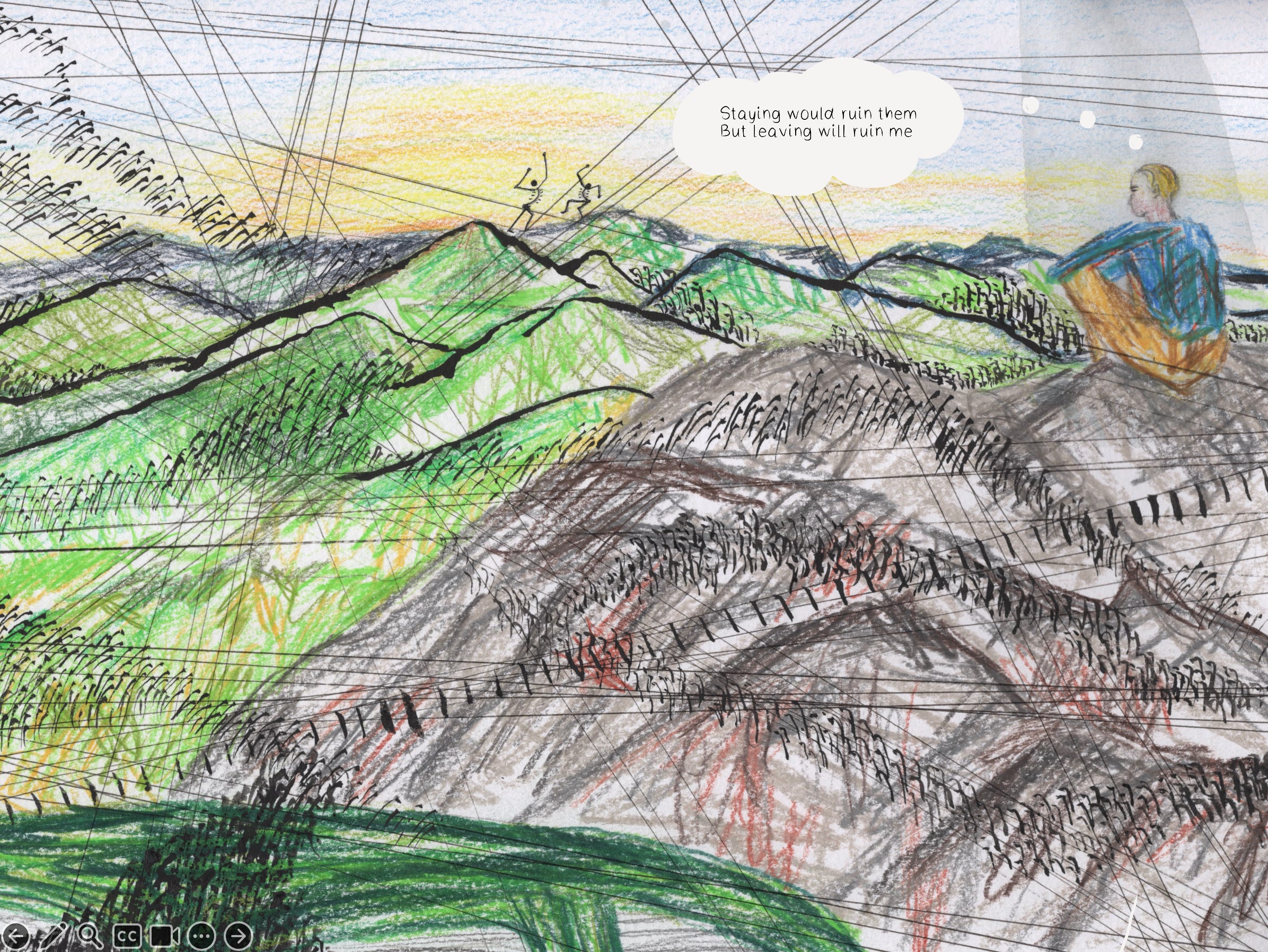
Figure 1: A spread from YIELD
My reflection here is on silence and the connection with this theme in YIELD my graphic novel in progress.
I’m not usually good at staying silent when it doesn’t matter. But a few months ago, at a dinner with friends, I was shocked by how easily I became speechless. My friends are excellent cooks and lively company, and I looked forward to a convivial evening. They’d also invited their neighbour, who I hadn’t met before and we all enjoyed jovial chit chat and strong cocktails. Then, as we took our places at the table, a verbal projectile was launched from the far end:
“Britain is under attack from immigrants and refugees. We just don’t have room for them.”
Adrenalin raced as I grasped for the responses I shout daily at the internet.
Of course there is room. Turkey hosts nearly four million refugees. Jordan, Germany and France all support larger refugee populations than the UK.
But while others around the table responded in various ways, I said nothing. I stayed silent. Afraid. Giddy with the shock of it. In my mind, the argument continued. Britain is not under attack. If anything, Britain becomes the attacker when it refuses shelter to people fleeing war, persecution, and harm. We should always say something. We have a responsibility to do so. As Audre Lorde writes:
“It is not difference which immobilizes us, but silence. And there are so many silences to be broken.”
I held back. I tolerated bigotry. I tolerated ignorance. I prioritised politeness over confrontation, keeping the peace over addressing an issue that is anything but peaceful.
I yielded through my silence
Why do we yield? How can change take place if we remain silent? To say nothing, even on a micro level, risks becoming a form of consent. Silence can enable hatred, violence and injustice to pass unchallenged.
The title of my graphic novel is YIELD. It is set at Black Mountain College in North Carolina during the 1930s, a place where radical artistic experimentation flourished through exploration and freedom of process. But, where art pushed boundaries, society built walls. Personal freedom was monitored, restricted, or silenced; by the college, society and the participants themselves exerting Foucauldian self-discipline or self-silencing.
Silence and Black Mountain College
Perhaps the artist most closely associated with Black Mountain College is the avant-garde composer John Cage. His most famous work, 4’33” (Four Minutes and Thirty-Three Seconds), was first performed in New York in 1952. [1] His score instructed the orchestra not to play, so the audience sat in silence. (Figure 2 shows my elderly uncle explaining John Cage’s piece to teenage me).
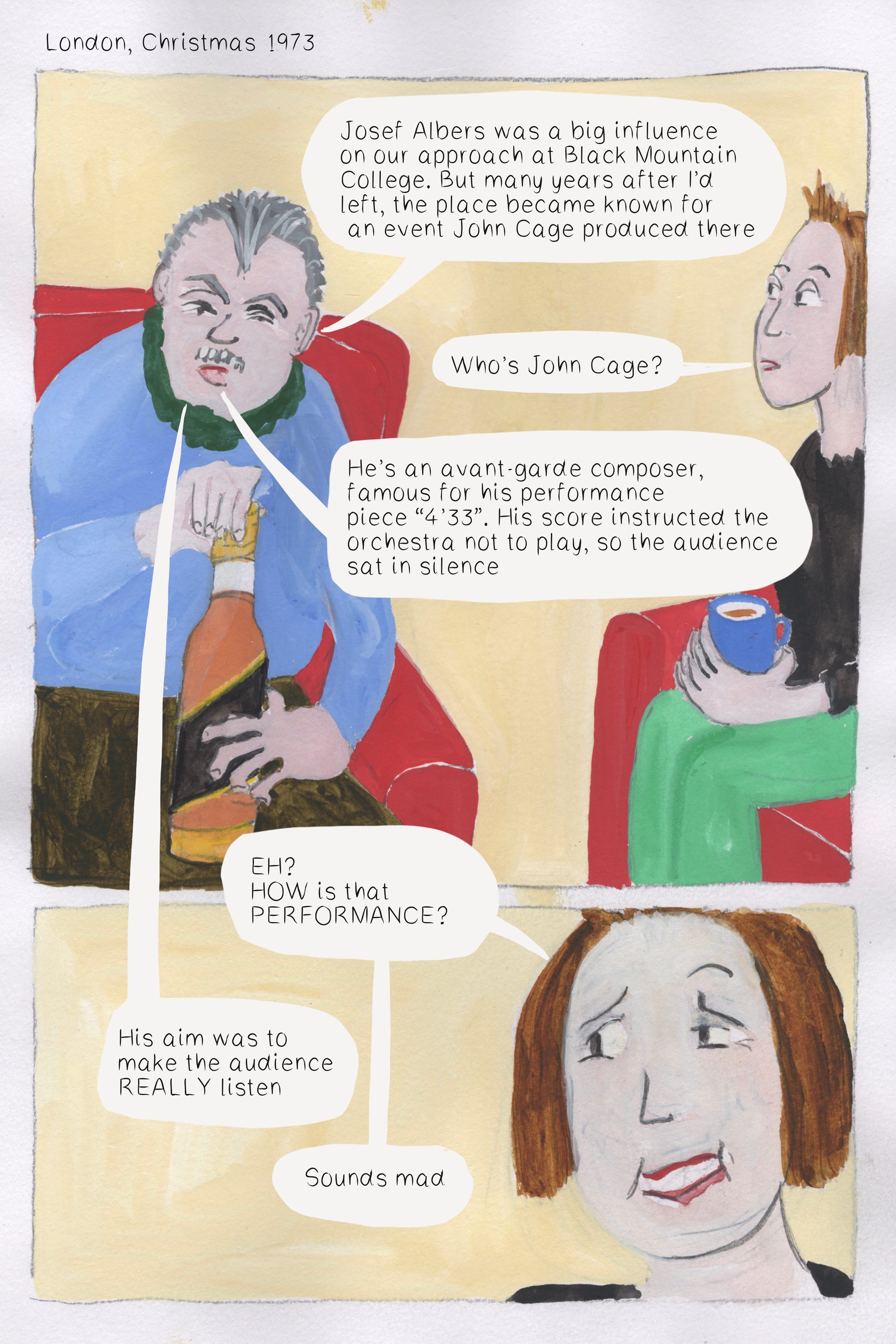
Figure 2: A page from YIELD
Cage’s piece invites us to consider that silence is never truly silent. Even in the absence of intentional sound, something is always present: ambient noise, bodily movement, thought, anticipation. Silence is not emptiness.
Whether imposed or voluntarily chosen, silence can function both as a tool of oppression and as a means of emancipation.
My narrative is inspired by the experiences of my uncle, one of the founding teachers at Black Mountain College in the 1930s. His silence about his sexuality was not freely chosen. It was imposed by the law and reinforced by the culture of the college itself. Silence, in this context, was a form of oppression.
By the time John Cage arrived at Black Mountain College two decades later, homosexuality remained illegal in the United States, but communities were increasingly organising, speaking and collectively challenging that oppression. Change became possible because silence was being broken.
Black Mountain College itself evolved as part of this shift. Its reputation as a space where people could live, create, and experiment collectively, often beyond the constraints of mainstream society is well documented in its archival history. Yet my uncle’s experience belonged to an earlier moment. The traces of his silencing are evident not only in the institutional record, but also in his personal diaries, where what remains unsaid is often as revealing as what is written.
This tension informed my decision to fictionalise the historical events in YIELD. Fiction allows me to explore the emotional and social realities that the archive cannot fully articulate, giving voice to experiences that could not be spoken openly at the time.
The specific example in my story is sexuality, but the pattern extends far beyond it. The same dynamics can be recognised in the histories of racial oppression, gender discrimination and other forms of exclusion. Again and again, systems of power depend upon silence, while movements for justice depend upon speech.
This tension between speaking and withholding, resistance and compliance, self-expression and self-censorship is what I mean by a bifurcation of self.
And a final reflection on silence
I wanted to finish with a note on how nice silence can be!
My BA degree and PhD were earned from the University of Sussex, where the motto “Be still and know” Vacate, et scire was adopted in 1961 two years after the university opened. It’s a quotation from the Bible (Psalm 46:10) “Be still and know that I am God”. It was chosen to encourage thinking and quiet reflection in the pursuit of knowledge in this new university set amidst green fields. Sussex was one of seven “new universities” opened in the 1960s as part of an initiative to democratize and expand higher education. The aim was to pioneer new ways of teaching, moving away from traditional, lecture-based models.
And by the way, if you ever meet anyone who studied at Sussex I can guarantee you they won’t be silent and knowing :)
Thank you for joining me here,
Love from Nicola x
[1] Cage’s connection with Black Mountain College was that during the summer of 1952 he staged the unscripted multidisciplinary event there, now widely known as Theatre Piece No. 1 or the “Untitled Event”. Today this is considered the first ‘happening’ and influenced the development of performance art.