IMAGINE if our Western understanding of education was based not on schooling, degrees, grades, curricula, modules, courses, subject choices, fees, loans, but instead on the process of learning for the sake of learning.
Some of my clearest memories from New End, my progressive state primary school in 1970s North London, are of “Thinking lessons”. At the time, I had no idea that these lessons were based on the ideas of Maltese physician and thinker Edward de Bono. In 1967, de Bono coined the term “lateral thinking” to describe a creative, indirect approach to problem-solving that moves beyond conventional linear or “vertical thinking”. His aim was to encourage people to explore ideas in new ways, challenging traditional patterns of thought and generating more innovative solutions.
In the glass-roofed art studio at the top of the Victorian building we mixed colour paints. Starting with a pure primary colour such as red we added white incrementally painting a line of circles of graduated tonal shades. I didn’t consider myself much of a drawer, but this exercise introduced a basic grounding and pleasure in colour theory that has stayed with me for life. De Bono believed that creative thought could be intentionally learned, practised, and used, rather than being an innate talent. His interest was in the process of learning rather than the product of learning.
IMAGINE if education was not associated in the western world with a product, a job, a debt, a means to repay a loan, the production of income, an active part of the capitalist machine, but instead with a journey, a process, with no preordained end point.
As a 10-year-old pupil in class, one example exercise we were given was to imagine all vehicles are yellow and to consider the advantages and disadvantages.
De Bono’s most well-known technique was the Six Thinking Hats approach, a framework designed to guide exploration of a topic from different perspectives. It was only years later that I made the connection between those early thinking lessons and de Bono’s theories, recognising the influence his ideas had on the way we were encouraged to think.
IMAGINE if we understood learning as a process to apply in problem-solving on a personal, national, and global level. Imagine if we concentrated on the right questions rather than the right answers.
Stripped down to underpants and vest, we lie on the floor of the head teacher’s office on that thin grey-blue carpet that attempts to soothe institutions. One boy is excused because he doesn’t have underpants. His smell goes unquestioned and unjudged by us. He is well-liked and leads spontaneous after school activity. Like when he showed us how to remove the logo emblems from parked cars, I still have a Jaguar, which he kindly let me keep. We do as Mr Spector says, close our eyes and imagine lying on the soft golden sand of a tropical island beach. He guides us through deep breathing.
Today I know how to travel to relaxation through breath. I know this in the way I know how to read, as something learnt so young that I’m seduced into believing it’s innate, instinctual; but it isn’t. Today, if I describe that “thinking lesson” it sounds out of time.
IMAGINE if in our daily journals we replaced our affirmations, gratitude, platitudes with daily questioning. Imagine reflecting on the world around us, including our own behaviours, through a lens of questions.
The school hall had a television set on a tall stand on permanently stationary wheels. Soon after the imaginary tropical island trip, I saw the head teacher watching himself being interviewed on TV. He must have been discussing the application of these experimental and progressive teaching methods. Whatever was happening at our school, it was enough to garner national press.
IMAGINE if our understanding of life was as a continuous learning journey. Imagine life and learning as the same, instead of learning as a separate segment of our lives. Imagine, instead of calling undergraduate “finals” we renamed them as undergraduate “prologues”.
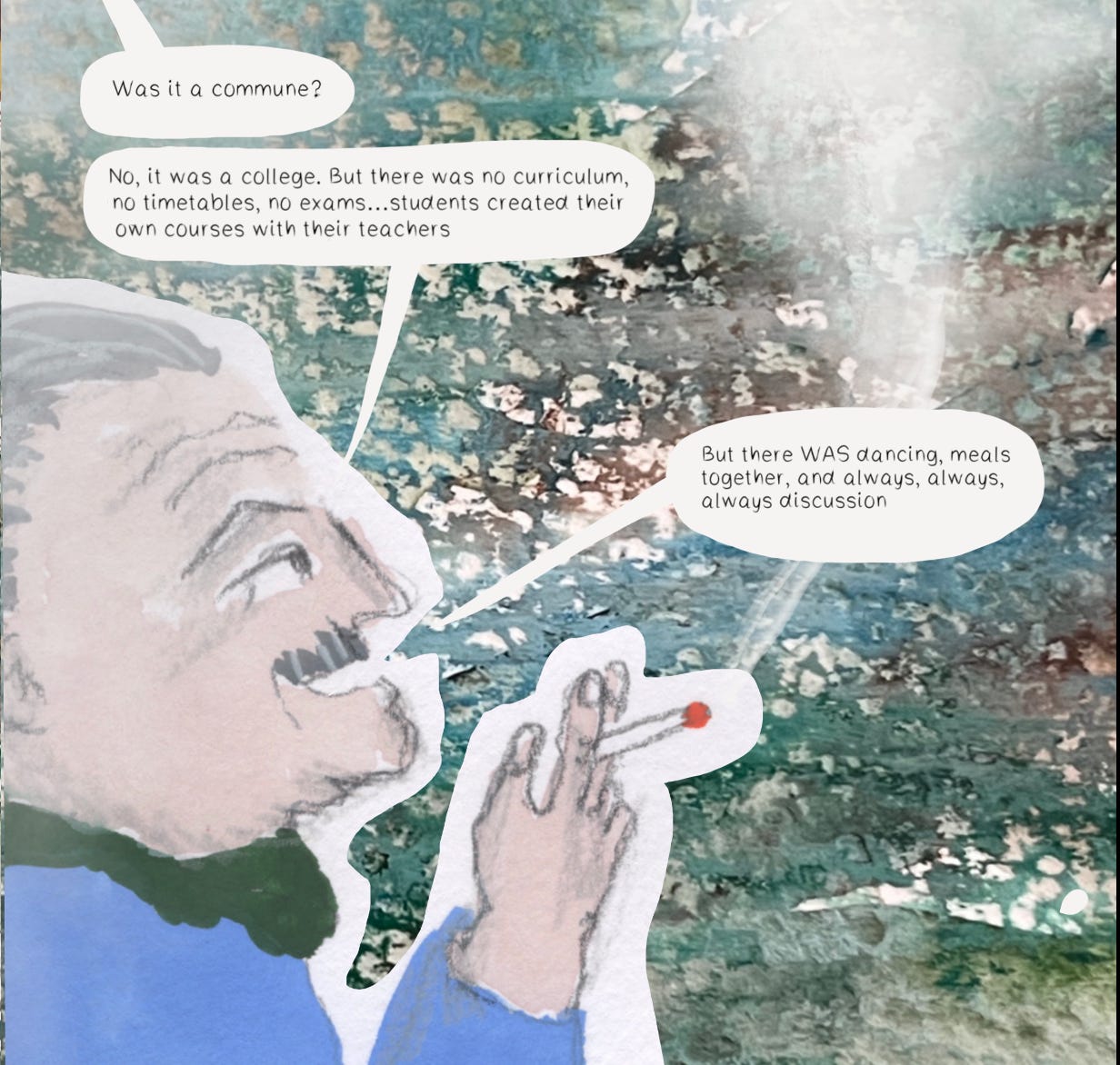
It is the assumptions we attach to the word “education” that make me hesitate to describe YIELD as being about Black Mountain College and education. The term suggests a focus on schooling, curriculum, and formal structures of learning, whereas I suspect that true education takes place within the minutiae of everyday life. It is in these small, often overlooked moments that we learn, share, and teach at a micro level, with the potential to influence and shape the wider world.
NEWS
CLOAKROOM LAUNCH
We have one week to go until the launch of the new addition to the Norfolk art scene. CLOAKROOM in Swaffham, Norfolk. John and I are feverishly cleaning, hanging artwork and gathering glasses ready to fill. If you can make it along to the launch, you’d be very welcome to join us.
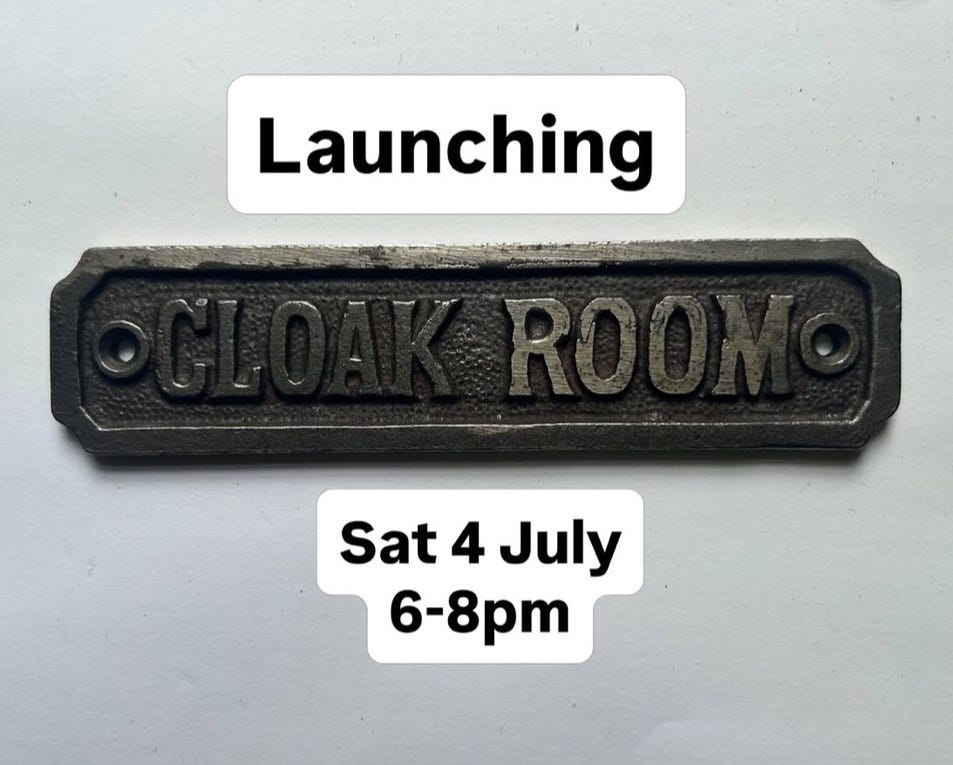
Saturday 4 July 6-8pm
Church Rooms, Camping Land
Swaffham, Norfolk PE37 7RB
CLOAKROOM is an artist-led space in a historic building in Norfolk, UK, initiated by The Grange Projects. It hosts a curated programme of public exhibitions, talks, and events, facilitated by artists John Plowman, Dr Nicola Streeten, and Sally Plowman.
Cloakroom’s core aim is to create a space where artists can explore, interrogate and experiment with what happens between inspiration and production within creative practice. It seeks to make these often-invisible processes visible across a range of disciplines and activities. This approach extends the ethos of The Grange Projects’ residency programme, which has been running since 2022.
DIAGRAPHIC 4 JULY - 29 AUGUST 2026
Emma Biggs
Ben Coode-Adams
Lee Grandjean
Marcia Mihotich
John Plowman
Freddie Robins
Opening Event Saturday 4 July 6-8pm
Exhibition open every Saturday 10am - 1pm between 11 and 29 July.
‘Diagraphic’ CLOAKROOM’s inaugural exhibition takes its cue from ‘Fig 7-Identify a Thing’ a work by Marcia Mihotich bringing together two dimensional works of six artists who are all makers of ‘things’. The works in this exhibition are neither finished or resolved in much the same way as the location of the exhibition, a Grade 2 listed former National School in Swaffham, Norfolk currently being renovated. Giving visibility to the often-invisible processes that occur between inspiration and production across a range of disciplines.
ACKNOWLEDGEMENTS
My substack posts and the work towards my final draft of my graphic novel YIELD are supported by an Arts Council England lottery project award